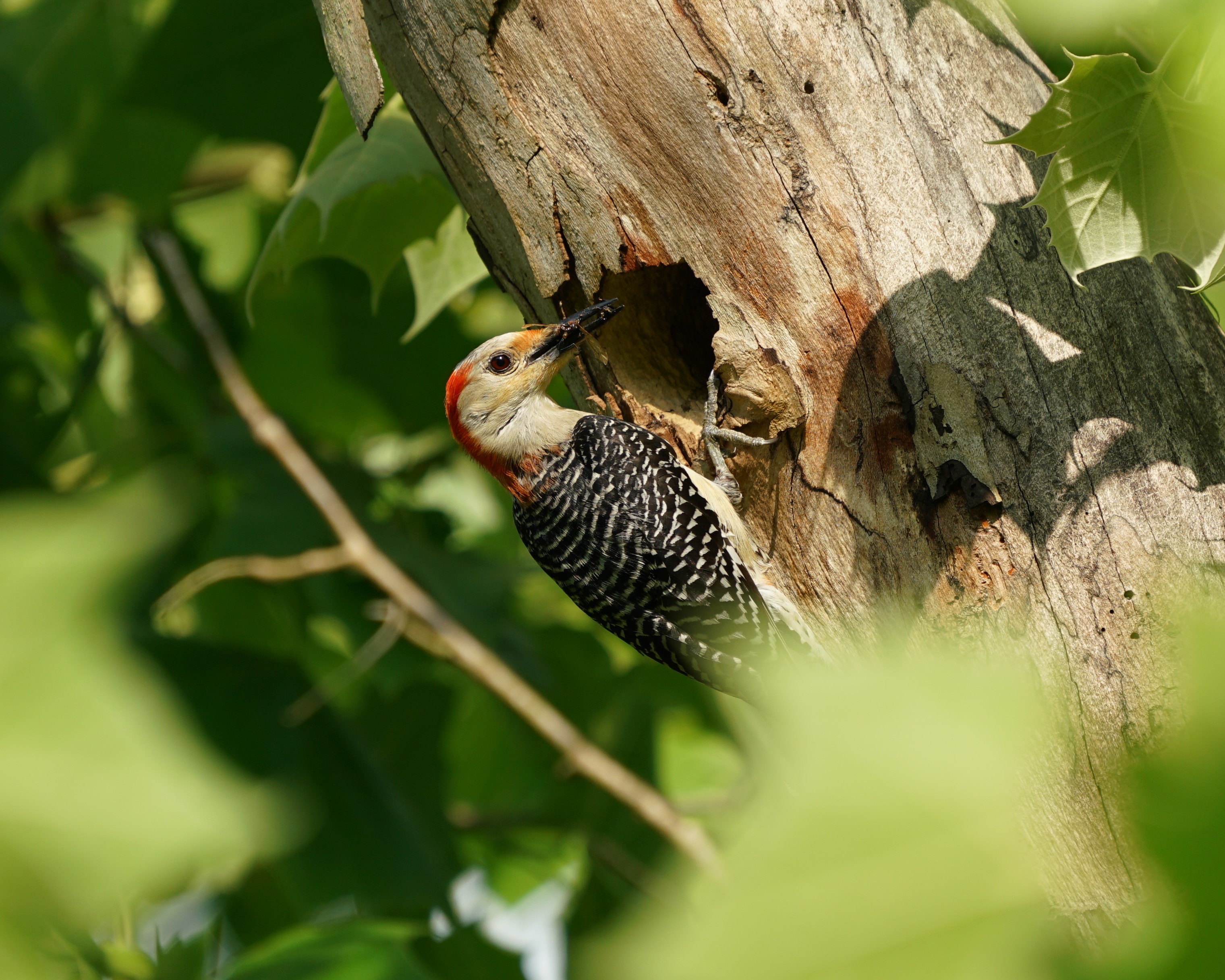


Red-Bellied Woodpecker
Appearance:
Length: 9.4 in Weight: 2.0-3.2 oz Wingspan: 13.0-16.5 in
As its name indicates, the belly is a light red or pinkish color. The red belly is often hidden from view as the bird perches or feeds against a tree trunk. Males are easily identifiable by the red coloration on the top of the head and neck. Females lack the red coloration on their head. The back is prominently striped horizontally with black and white barring. A white patch at the base of the primary feathers is highly visible in flight.
Males have a longer bill and a longer, wider tongue than females. These physical differences may allow the male to reach deeper into furrows to obtain food items. Researchers suggest these slight physical differences are an adaptation to allow the sexes to divide up the resources in one area.
The red-headed woodpecker, a similar species, has red on the entire head, neck, face, and throat and has bold black and white patches on the back. The red-headed woodpecker lacks the horizontal barring on the back of the red-bellied woodpecker.
Habitat:
Red-bellied Woodpeckers are the most common woodpecker in the southeast, and are found in a wide array of deciduous or coniferous forested habitats or suburban areas.
Behavior:
Unlike many other woodpeckers, the red-bellied diet consists of more fruit than insects. The fruit items in its diet are highly variable but include many wild berries. It hangs upside down when feeding on berries. It also feeds on acorns, beech mast, seeds, beetles, grasshoppers, ants, and other insects. Its bill is used to probe for insects in trees and stumps. This bird is also known to store or cache food items in cracks and crevices of trees, fence posts, and other wood products.